


$5 million NHMRC grant to help Peter Mac crack immune resistance in advanced cancer
08 January 2026
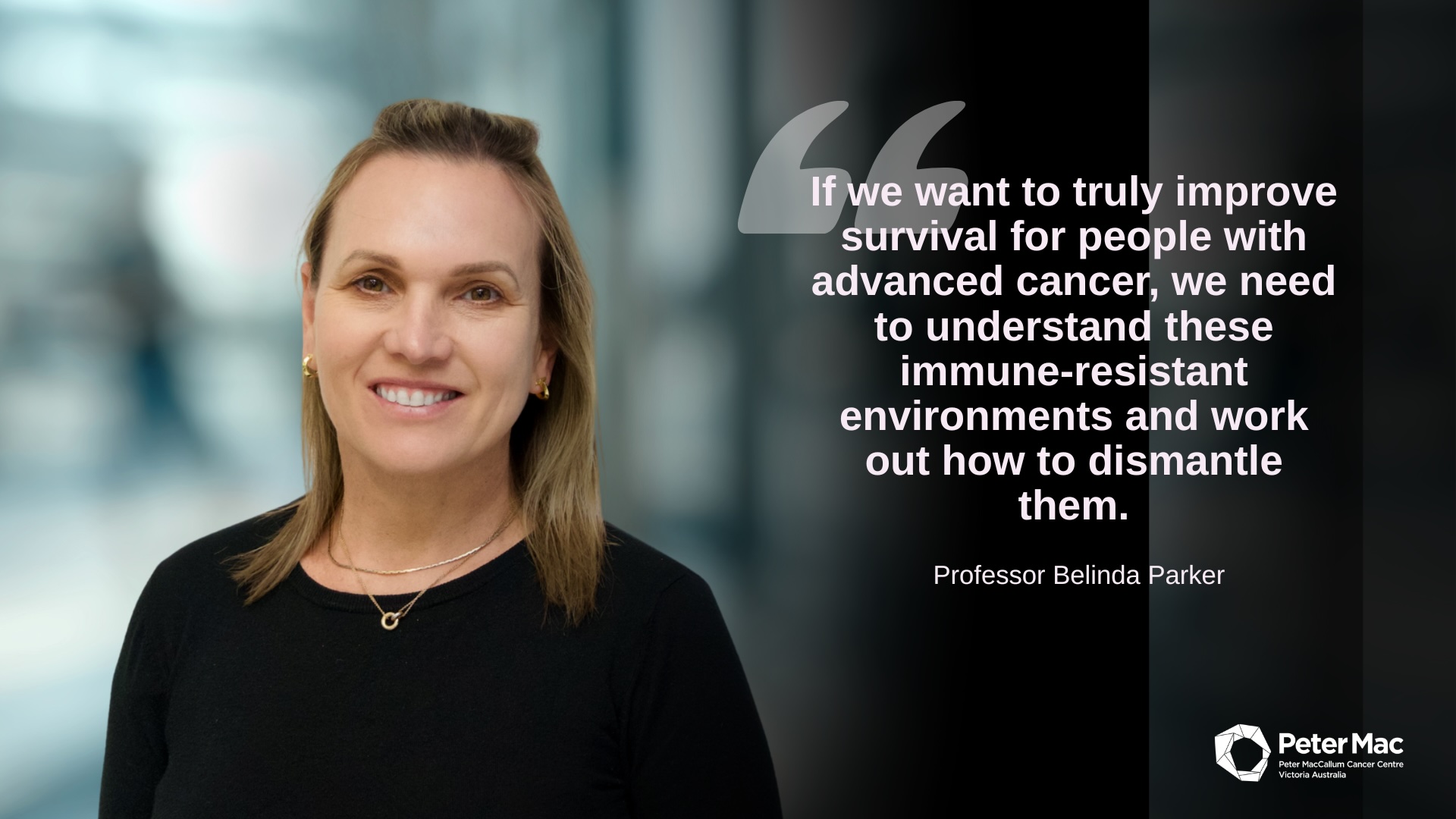
Professor Belinda Parker will spearhead a new $5 million research project funded by the National Health and Medical Research Council (NHMRC) to develop approaches to target aggressive metastatic cancers with immunotherapy.
Immunotherapy has transformed outcomes for some patients with cancers like melanoma, lung cancer and triple-negative breast cancer, offering long-lasting responses where few options once existed. But for people with stage 4 cancers such as breast and prostate, survival rates remain stubbornly low.
Professor Parker said this is because most research has focused on primary tumours, rather than the distant metastases that often evolve in ways that make them harder to treat.
“Metastases are not just simple extensions of the original cancer – they change and adapt, creating their own protective environments that help them hide from the immune system,” Professor Parker said.
“If we want to truly improve survival for people with advanced cancer, we need to understand these immune-resistant environments and work out how to dismantle them.”
The project brings together a team of experts in immunology, oncology, metastasis modelling and advanced cancer biology from Peter Mac (Belinda Parker, Sherene Loi, Paul Beavis, Ian Parish, Declan Murphy) the Peter Doherty Institute (Laura Mackay) and the Faculty of Engineering, University of Melbourne (Ivan Marusic).
They will use state-of-the-art approaches, including a rapid autopsy program, to study how immune escape mechanisms develop and test new strategies to overcome them.
These strategies include boosting the visibility of metastatic tumour cells to the immune system, engineering T cells to carry immune-activating “cargo” to metastases, and finding ways to strengthen the body’s own T cell response.
“This is about creating a new pipeline for precision immunotherapy,” Professor Parker said.
“Our ultimate goal is to expand the benefit of immunotherapy beyond those who respond today, and bring hope to many more people facing advanced cancer.”
Find out more about the Belinda Parker Lab.