

Boost for fundamental research at Peter Mac from new ARC discovery grants
07 November 2025
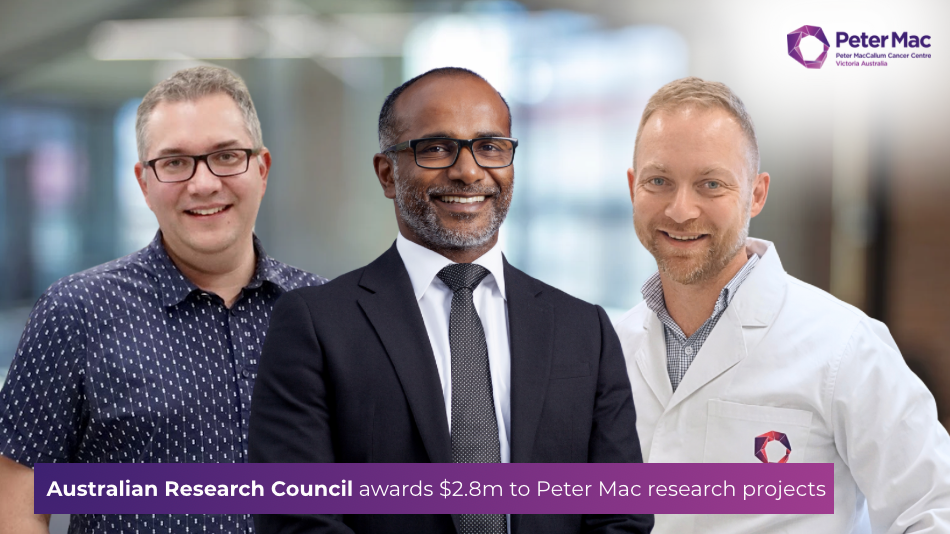
The Australian Research Council has awarded over $2.8 million to Peter Mac-University of Melbourne researchers to facilitate their groundbreaking fundamental research.
The ARC Discovery Projects scheme is a highly coveted program which provides funding for multidisciplinary basic science programs in Australia, enhancing the research capacity for high-quality projects that contribute to the advancement of knowledge and innovation.
Professor Ricky Johnstone, Peter Mac’s Executive Director of Cancer Research, said, the extensive funding awarded to Peter Mac researchers through the ARC Discovery Projects scheme is testament to the importance and high value we place on innovative discovery science conducted here in partnership with the University of Melbourne.
“These grants ensure that Australian science continues to have an impact on the global economy with essential knowledge creation and downstream commercial and environmental benefits,” he said.
Three Peter Mac researchers have been awarded lead grants to advance their research within their respective fields:
Professor Mark Dawson, is also based at the Collaborative Centre for Genomic Cancer Medicine (a joint venture of the University of Melbourne and Peter Mac), has received funding for his research seeking to further understand a process called “co-transcriptional splicing”. This is where a cell makes a copy of a gene’s DNA and edits this to form mature mRNA, which acts as a set of instructions for making a protein. These complex processes are vital for nearly every biological function yet are still not fully understood. Professor Dawson’s research seeks to give scientists a clearer picture of how these processes work.
Associate Professor Andrew Cox has received a grant to investigate how injured tissues, such as the liver, repair themselves. His team has already found that changes in cell metabolism control tissue repair. Using zebrafish, they will investigate the role of stem cells in the repair process, which could enhance our understanding of how tissues heal.
Professor Ben Hogan has received a grant for his research on how the lymphatic system can regenerate and repair itself. This process is not well understood, and his research will be the first of its kind. The findings could lead to new ways to improve tissue repair, healing, and healthy ageing.
Two non-lead researchers are also taking part in research which has received ARC funding; Dr Ajithkumar Vasanthakumar for a study on intestinal regulatory T cells which work with the immune system to keep the gut healthy, and Associate Professor Louise Cheng for research on how the pH influences how cells communicate with each other.